


KUP 44: Have knowledge of the precautions to be taken to prevent pollution of the marine environment

Learning objective:
1. Understanding Pollution Sources.
2. Have Knowledge on adherence to International Regulations.
3. Have Knowledge on emergency preparedness and response.
4. Have knowledge on collaboration and reporting.
Content
- Pollution Sources
Oil pollution at sea can originate from several onboard sources, each contributing to the contamination of marine environments. One significant source is the accumulation of oil in the bilge wells of the engine room, which can lead to potential discharges if not properly managed. Additionally, oil spills are a common risk during the loading and unloading of cargo on tankers, often resulting from hose failures, human error, or equipment malfunctions. Another major source of pollution is contaminated ballast water from fuel tanks, which can introduce oil into the marine environment when discharged. Tank washing and ballast operations also pose a risk; improper management during these processes can result in significant oil discharges. Moreover, various other onboard activities, such as maintenance and equipment cleaning, can contribute to oil pollution if not carefully controlled. Finally, tank accidents, such as those caused by collisions or groundings, can lead to large-scale oil spills, causing severe environmental damage.
To mitigate these risks, it is crucial to identify potential sources of oil pollution, such as bilge wells, ballast tanks, fuel tanks, and tank washing operations. Ensuring regular maintenance and monitoring of all relevant equipment and systems is essential to prevent leaks and spills. Implementing strict operational procedures, training crew members, and maintaining an emergency response plan are vital steps in minimizing the impact of oil pollution from ships. By addressing these sources and taking preventive measures, the maritime industry can significantly reduce its environmental footprint and protect marine ecosystems.
Main Onboard Sources of Oil Pollution at Sea:
Bilge Wells in the Engine Room:
- Oil can accumulate in the bilge wells of the engine room, leading to potential discharges.
Ballasting of Fuel Tanks:
- Contaminated ballast water from fuel tanks can introduce oil into the marine environment.
Cargo Operations on Tankers:
- Oil spills can occur during the loading and unloading of cargo on tankers.
Tank Washing and Ballast Operations:
- Cleaning of tanks and ballast operations can result in oil discharge if not properly managed.
Other Operations:
- Various other onboard activities can contribute to oil pollution if not carefully controlled.
- For example, oil residuals from open-loop scrubbers that utilize seawater to scrub the exhaust gases.
Tank Accidents:
Accidental damage to tanks can lead to significant oil spills.

2. International Regulations
2.1 MARPOL Compliance
- The International Convention for the Prevention of Pollution from Ships (MARPOL) is the main international convention covering the prevention of pollution of the marine environment by ships from operational or accidental causes, and its six annexes cover oil, noxious liquid substances, harmful substances in packaged form, sewage, garbage, and air pollution [1].
- Key Regulations:
MARPOL Annex I [2] – Prevention of Pollution by Oil
| Chapter | Regulations | Content |
| 1 | 1-5 | General, Definitions, Application |
| 2 | 6-11 | Inspections and Certification. Administration and Port State Control (PSC) |
| 3 | 12-17 | Machinery Spaces. Construction, Bilge Control, and Equipment (All Ships) |
| 4 | 18-36 | Cargo Areas. Construction, Bilge Control, and Equipment (Oil Tankers) |
| 5 | 37 | Shipboard Oil Pollution Emergency Plan (SOPEP) |
| 6 | 38 | Reception Facilities |
| 7 | 39 | Floating Production Storage and Offloading (FPSO) and Floating Storage Units (FSU) |
Description of the requirements and measures for preventing oil pollution from ships (Annex I).
MARPOL Annex II – Prevention of Pollution by Noxious Liquid Substances in Bulk
- Measures for controlling harmful substances carried in bulk.
- 250 substances were identified.
- Under certain circumstances, it is prohibited to discharge residues of harmful substances within 12 nautical miles from the shore.
| Chapter | Regulation | Content |
| 1 | 1-5 | General Information |
| 2 | 6 | Categorization of Noxious Liquid Substances |
| 3 | 7-10 | Inspections and Certification |
| 4 | 11-12 | Construction, Design, Arrangements, and Equipment |
| 5 | 13-15 | Operational Discharges of Noxious Liquid Substances |
| 6 | 16 | Control Measures by Port States |
| 7 | 17 | Prevention of Pollution in Case of an Incident |
| 8 | 18 | Reception Facilities and Arrangements at Discharge Terminals |
Annex III – Prevention of pollution by harmful substances packaged and transported by sea.
Requirements for standards on packing, marking, documentation, storage, and volume limitations of harmful substances transported by sea.
- Reg 1) Application
In this Annex, “harmful substances” are defined as those substances identified as marine pollutants in the International Maritime Dangerous Goods (IMDG) Code, or that meet the criteria in the appendix to this Annex.
Annex IV – Prevention of pollution from sewage from ships
Discharges directly into the sea less than 3 nautical miles from land are prohibited unless the ship has a treatment system:
- If the discharge is comminuted and disinfected with an approved system, it can be released 3 nautical miles from land.
- If it is not comminuted and disinfected, the requirement is at least 12 nautical miles from land.
| Capital | Regulation | Capital |
| 1 | 1-3 | General Information |
| 2 | 4-8 | Inspections and Certification |
| 3 | 9-11 | Equipment and Discharge Control |
| 4 | 12 | Reception Facilities |
| 5 | 13 | Port State Control |
Measures to control the discharge of sewage.
Annex V – Prevention of Pollution by Garbage from Ships
- Describes different types of garbage and specifies the distance from land and the manner in which a ship can dispose of each type of garbage.
- Describes the complete prohibition of the discharge of all forms of plastic into the sea.
2.2 Ballast Water Management Convention (BWM Convention)
- The International Convention for the Control and Management of Ships’ Ballast Water and Sediments (BWM Convention) was adopted by consensus at a Diplomatic Conference held at IMO Headquarters in London on 13 February 2004. The BWM Convention entered into force on 8 September 2017.
- The Convention requires all ships to implement a Ballast Water Management Plan. All ships have to carry a Ballast Water Record Book and are required to carry out ballast water management procedures to a given standard. Parties to the Convention are given the option to take additional measures which are subject to criteria set out in the Convention and to IMO guidelines.
- Annex Provisions:
- General Provisions (Section A): Defines terms, applications, and exemptions.
- Management and Control (Section B): Details the requirements for ballast water management plans, record books, and specific management practices.
- Standards (Section D): Includes ballast water exchange and performance standards to ensure environmental protection.
- Survey and Certification (Section E): Outlines requirements for surveys and certification, including forms for certificates and record books.
- Key Regulations:
- Ballast Water Exchange Standard (D-1): Requires 95% volumetric exchange efficiency.
- Ballast Water Performance Standard (D-2): Specifies limits on viable organisms and indicator microbes in discharged ballast water.
- Approval Requirements (D-3): Details the approval process for ballast water management systems, including those using chemicals or biological mechanisms.
- Prototype Technologies (D-4): Allows for the testing and evaluation of new treatment technologies.
- Review of Standards (D-5): Mandates periodic standards review to ensure safety, environmental acceptability, practicability, cost-effectiveness, and biological effectiveness.
- The Ballast Water Management module contains information on the following items as required by the BWM Convention:
- Exemptions granted to ships under regulation A-4;
- Ballast water exchange areas designated under regulation B-4.2;
- Additional measures under regulation C-1; and
- Warnings concerning ballast water uptake in certain areas and related flag State measures under regulation C-2.
- The links to the right provide access to other modules that contain information also required by the BWM Convention, as follows:
- Type-approved ballast water management systems in accordance with Guidelines (G8) or the BWMS Code, in the ‘Pollution Prevention Equipment and Anti-fouling Systems’ module;
- Contact points for applications for exemptions in accordance with Guidelines (G7), in the ‘Contact Points’ module;
- Availability of reception facilities for ballast water and sediments and alleged inadequacies related to sediment reception facilities in accordance with articles 5 and 14, in the ‘Port Reception Facilities’ module; and
- Responsibilities and conditions of the authority delegated to nominated surveyors or recognized organizations in accordance with regulation E-1, in the ‘Recognized Organizations’ module.
2.3 Convention on the Prevention of Marine Pollution by Dumping of Wastes and Other Matter (London Convention)
The purpose of the London Convention is to control all sources of marine pollution and prevent pollution of the sea through regulation of dumping into the sea of waste materials. A so-called “black- and grey-list” approach is applied for wastes, which can be considered for disposal at sea according to the hazard they present to the environment. For the blacklist items dumping is prohibited. Dumping of the grey-listed materials requires a special permit from a designated national authority under strict control and provided certain conditions are met. All other materials or substances can be dumped after a general permit has been issued.
3. Emergency Preparedness and Response
3.1 Contingency Planning
MARPOL Annex I – Prevention of Pollution by Oil:
Regulation 15) Control of Oil Discharge.
Regulation 2) Any discharge of oil or oily mixtures into the sea from ships of 400 gross tonnage or more is prohibited, except when all the following conditions are met:
- The ship is en route.
- The oily mixture is processed through oil filtering equipment that meets the requirements of Regulation 14 of this Annex (special areas apply Regulation 14.7).
- The oil content of the effluent without dilution does not exceed 15 parts per million.
- The oily mixture does not originate from the bilge of cargo pump-rooms on oil tankers.
- In the case of oil tankers, the oily mixture is not mixed with oil cargo residues.
Regulation 4) For the Antarctic area, any discharge of oil or oily mixtures from all ships into the sea is prohibited.
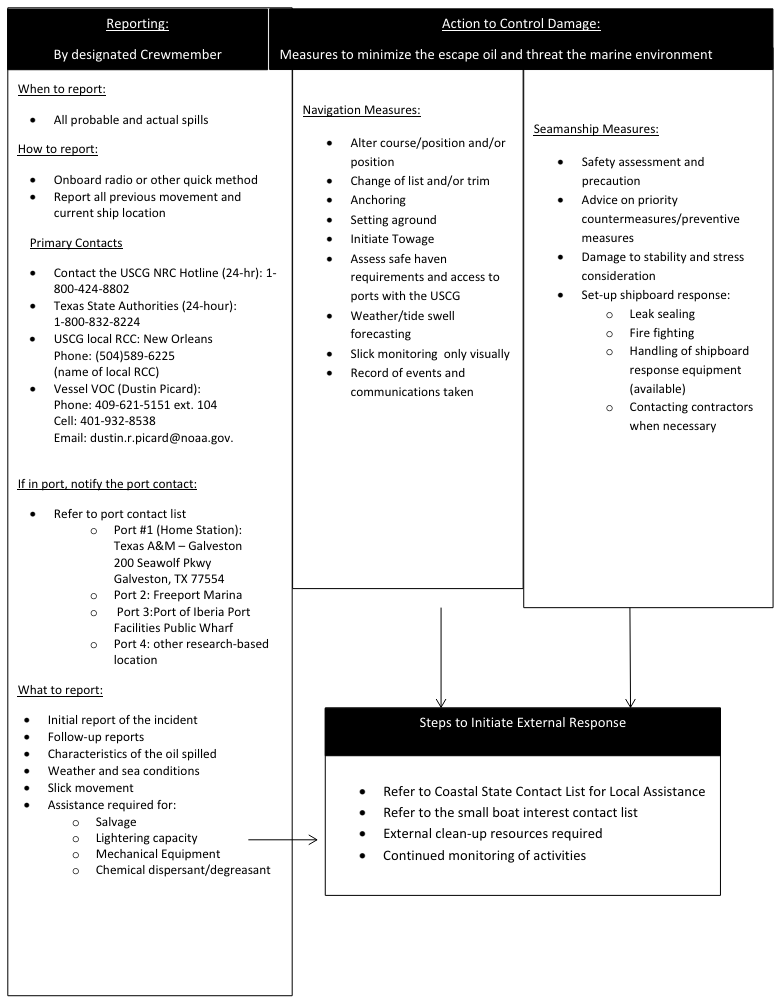
Regulation 37) Shipboard Oil Pollution Emergency Plan (SOPEP) [3].
All oil tankers of 150 gross tonnage or more, and all ships of 400 gross tonnage or more that are not oil tankers, must have on board a Shipboard Oil Pollution Emergency Plan (SOPEP) approved by the administration.
This plan must be developed based on the guidelines provided by the organization and must be written in the working language of the ship’s master and officers. The plan must at a minimum include:
Reference is made to the “Guidelines for the development of shipboard oil pollution emergency plans,” adopted by the organization by resolution MEPC.54(32), as amended by resolution MEPC.86(44).
- Shipboard Oil Pollution Emergency Plan (SOPEP)-Summary Flowchart [4]:
3.2 Guidelines for the development of shipboard oil pollution emergency plans
The Plan shall consist at least of:
• the procedure to be followed by the master or other persons having charge of the ship to report an oil pollution incident
• the list of authorities or persons to be contacted in the event of an oil pollution incident
• a detailed description of the action to be taken immediately by persons on board to reduce or control the discharge of oil following the incident; and
• the procedures and point of contact on the ship for coordinating shipboard activities with national and local authorities in combating pollution.
3.3 Response Equipment
Ensuring the availability and proper maintenance of pollution response equipment, such as oil spill containment and recovery tools.
The equipment used to respond to a spill includes a wide range of booms, pumps, oil skimmers and dispersant chemicals.
Oil recovery vessels:
- Ensuring the availability and proper maintenance of pollution response equipment, such as oil spill containment and recovery tools.
- The equipment used to respond to a spill includes a wide range of booms, pumps, oil skimmers and dispersant chemicals.
- Oil recovery vessels:
- collect and retrieve oil with the assistance of a skimmer
- apply dispersant
- position other oil spill equipment
- store the recovered oil in on-board storage tanks
- pump the recovered oil to another vessel or tank.
4. Collaboration and Reporting
4.1 Incident Reporting:
- Establishing clear protocols for reporting pollution incidents to relevant authorities promptly.
4.2 Stakeholder Engagement:
- Collaborating with stakeholders, including port authorities, environmental organizations, and regulatory bodies, to enhance pollution prevention efforts.
4.3 Continuous Improvement:
- Regularly reviewing and improving pollution prevention measures based on feedback and new developments in regulations and technology.
Recommendation
More information about the marine pollution emergency plans can be checked out here: https://www.imo.org/en/OurWork/Environment/Pages/Shipboard-Marine-Pollution-Emergency-Plans.aspx
Reference
-
History of MARPOL. https://www.imo.org/en/KnowledgeCentre/ConferencesMeetings/Pages/Marpol.aspx
-
MARPOL Annex I – Prevention of Pollution by Oil. https://www.imo.org/en/OurWork/Environment/Pages/OilPollution-Default.aspx
-
Shipboard Marine Pollution Emergency Plans. https://www.imo.org/en/OurWork/Environment/Pages/Shipboard-Marine-Pollution-Emergency-Plans.aspx
- Shipboard Oil Pollution Emergency Plan (SOPEP). https://www.omao.noaa.gov/sites/default/files/documents/SOPEP%20Example%20-%20MANTA%20-%202017%200702.pdf