


KUP 32: Ability to transmit and receive, by Morse light, distress signal SOS as specified in Annex IV of the International Regulations for Preventing Collisions at Sea, 1972, as amended, and appendix 1 of the International Code of Signals, and visual signalling of single-letter signals as also specified in the International Code of Signals

Learning objective:
The International Code of Signals (INTERCO) is for visual, sound and radio communications, as introduced in KUP 31. This lesson aims to introduce the details of flag signaling, Morese code, and distress signals. The learning objective is to: 1) acquire the meaning of single-letter signals; 2) how to present the single-letter signal by flag and morse light; 3) how to signal the distress signals.
Learning content:
1. Flag signaling:
Nautical flags are most common in the forms of squares, but you can also see pendants and triangles. There are 26 square nautical flags representing the letters of the alphabet. There are also 10 numbered pendants, one answering pendant and three substitutes.
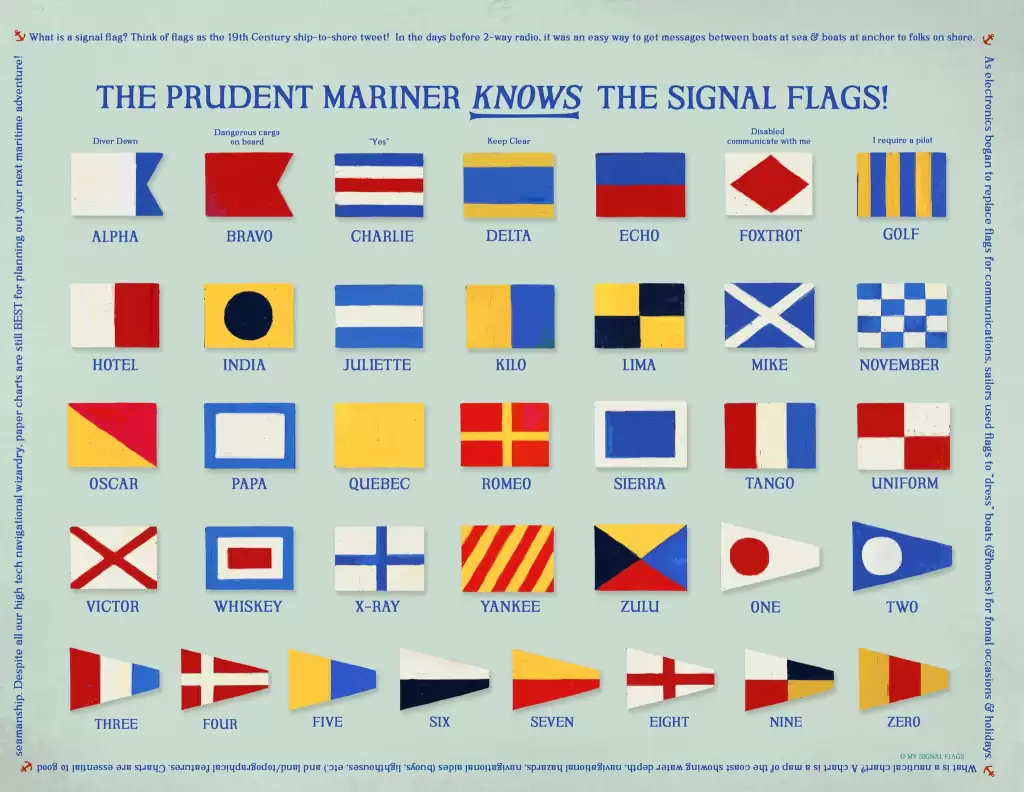
Flag signal 1.
1.1 The Nautical Flag Alphabet
The international code of signals for the letters of the alphabet are as follow:
- A: Alpha – diver down; keep clear
- B: Bravo – carrying dangerous cargo
- C: Charlie – yes (affirmative)
- D: Delta – keep clear of me, I am maneuvering with difficulty
- E: Echo – altering course to starboard
- F: Foxtrot – I am disabled, communicate with me
- G: Golf – I want a pilot
- H: Hotel – a pilot on board
- I: India – I am altering my course to port
- J: Juliet – vessel on fire keep clear
- K: Kilo – I want to communicate with you
- L: Lima – stop your vessel instantly, I have something important to communicate; Come Within Hail or Follow Me (Sailing Regatta)
- M: Mike – my vessel is stopped and making no way through the water; Mark Missing (Sailing Regatta)
- N: November – no (negative); Abandonment and Re-sail (Sailing Regatta)
- O: Oscar – Man overboard
- P: Papa – In port: All personnel return to ship; vessel is about to sail; At sea: It may be used by fishing vessels to mean: “My nets have come fast upon an obstruction”
- Q: Quebec – I request free pratique
- R: Romeo – reverse course
- S: Sierra – engines are going astern
- T: Tango – Keep clear; engaged in trawling. (International); Do not pass ahead of me. (Navy)
- U: Uniform – you are heading into danger
- V: Victor – require assistance
- W: Whiskey – require medical assistance
- X: X-ray – stop your intention
- Y: Yankee – am dragging anchor
- Z: Zulu – I require a tug
1.2 Depending on the message, vessels fly one flag or up to seven flags in a row:
- One-flag signals are urgent or common signals.Two-flag signals are used for distress or maneuvering.
- Three-flag signals are used for compass, relative bearings, standard times, verbs, punctuation and also general code and decode signals.
- Four-flags are used for geographical signals, names of ships…
- Five-flag signals are used to relate time and position of the ship.
- Six-flags are used to indicate main cardinal directions in latitude and longitude signals.
- Seven-flags are for longitude signals that contain more than 100º
1.3 Besides the solo meaning seen above, combination of flags mean different things as:
- Combining the D (Delta) and V (Victor) flags mean “I’m maneuvering with difficulty and require assistance”.
- The J (Juliet) and L (Lima) flags mean “you’re running the risk of going aground”.
1.4 The use of substitutes:
The use of substitutes is to enable the same signal flag, either alphabetical flag or numeral pennant, to be repeated
one or more times in the same group, in case only one set of flags is carried on board. The first substitute always
repeats the uppermost signal flag of that class of flags
2. Morse code
Morse code is a telecommunications method which encodes text characters as standardized sequences of two different signal durations, called dots and dashes, or dits and dahs. The dots and dashes and spaces between them should be made to bear the following ratio, one to another, as regards their duration:
(a) A dot is taken as the unit;
(b) A dash is equivalent to three units;
(c) The space of time between any two elements of a symbol is equivalent to one unit; between two complete symbols it is equivalent to three units; and between two words or groups it is equivalent to seven units.
3. Distress signal SOS
SOS is recognized as a standard distress signal that may be used with any signaling method. It has been used as a visual distress signal, consisting of three short/three long/three short flashes of light. At ship, more details of distress signals are listed below:
Recommendation: